Showing posts with label gothic. Show all posts

Friday, July 12, 2013

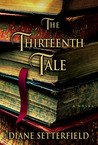
The Thirteenth Tale, by Diane Setterfield: a Review

The Thirteenth TaleThe Thirteenth Tale by Diane Setterfield

My rating: 5 of 5 stars


In brief, I thoroughly enjoyed this book.
This was the first book that grabbed my attention hard enough for me to finish it with a grabby and demanding baby. 
A modern Gothic novel that reminiscent of Jane Eyre with delicious family secrets taken to the grave, and mysteries burning to be uncovered, The Thirteenth Tale was written with entrancing prose.  I particularly enjoyed the unusual word choices which made me feel as though Setterfield spent many hours poring over her work until every single word in The Thirteenth Tale was chosen for both beauty and precise meaning.
Though the tale ranges from the scandalous to bizarre, and mysteries are layered upon mysteries ever edging along the paranormal, they never fully step outside the realm of the believable.  Though the scandals are salacious, they are never described in the sort of sordid detail I've come to cringe through in many a similar tale. I greatly appreciated that Setterfield respected the story enough to tell the tale without gratuitous scenes of any sort. If it is in the book, it is a deeply intrinsic piece of the tale.  I admire the restraint apparent in the construction of The Thirteenth Tale.
It's a book I would recommend to nearly anyone over the age of 15 looking for an enigmatic tale, and it is one which I plan to read again.

Friday, July 05, 2013

The Dark Unwinding, by Sharon Cameron: a Review

The Dark UnwindingThe Dark Unwinding by Sharon Cameron

My rating: 3 of 5 stars


The Dark Unwinding by Sharon Cameron, ultimately, confused me. Not the plot, it was all set up well and easy enough to follow, with just enough foreshadowing to make the story gel, but not overly insult the reader by leading them by the hand. Well, maybe there was a little bit of hand holding, and really, only one of the twists was remotely surprising, but that's okay. Really, I like a book that doesn't side swipe me, because I feel that's usually the result of lazy writing.
However, I do have a word-choice bone to pick with Cameron. It makes my skin crawl to hear phrases like "tea things" thrown about when there are perfectly good descriptive and common terms. Maybe I'm wrong and tea service was called "tea things" during the 1870s, and I just don't know about it. I admit, this may be the first book I've read that was set in such a time period, to the best of my knowing. However, I doubt it.
I know it's a silly thing for me to complain about, but when reading a period piece, word choice can make or break a book in terms of suspension of disbelief, and for me, that one broke it every time.
Would I read a sequel? Yes. Would I recommend it to my teenage daughter? Probably. Would I herald it as a steampunk triumph? No.Why not? It has all of the elements, mechanized wonders as a plot point, utopian experiments, manners; it really should be. However, those elements truly played a setting role, and were specific only to the immediate locale, while the rest of the world went on completely as history recalls it. That isn't a bad thing, I just don't recommend it if you are looking for a deeply alternate timeline.
I don't believe it was intended as a steampunk novel, to be clear, but any book with a lot of gears on the cover will likely be expected to be so.

I feel like I should be reviewing this book based on feminist and mental health grounds, but alas, I haven't had enough time to fully dissect it all. I do, however, think that a certain amount of sizeism in the first chapter was unnecessary and unfavorably colored my view of the book, all the while recognizing that in a period piece, it is difficult to assign the same gravity to such things as in a modern piece. Was a character repeatedly mocked on account of weight? Yes. Was weight used as a metaphor for stupidity? Yes. Is that ever okay? No. Is it plausible that it may have been the prevailing notion at the time? Yes. Nevertheless, there are other ways to paint a character as impulsive and unintelligent other than calling them fat.

In terms of women's roles, well, the swooning is a little thick.

Saturday, June 01, 2013

In the Shadow of Blackbirds, by Cat Winters: a Review

In the Shadow of BlackbirdsIn the Shadow of Blackbirds by Cat Winters
My rating: 5 of 5 stars

When Cat Winters was a young girl, she watched an episode of Ripley's Believe it or Not which featured the fairy photographs taken by cousins Elsie Wright and Frances Griffiths. As a reader, I am grateful that she did because the interest in the WWI era, spiritualism, photography, and the horrors of the Spanish Influenza came together in a marvelous story of young love, tragedy, and the value of tenacity.

Immediately, Winters' impresses with her use of voice and back story. The motion of Mary Shelley's journey and the rhythm of the prose meld seamlessly. In the Shadow of Blackirds reflects deep research without flaunting it. The cast was uncluttered, the memories pertinent, the characters well formed, and to give credit where it's due- they physical book is beautiful.

Tip of the hat to the genius who decided to write the story in black on white and the author's note, acknowledgements, dedication and copyright page in white on black. The typeface is elegant, chapter headers interesting, and although the cover art frustrated me in that it only nearly recreates an image featured in the story, it's pretty fantastic as well.

Loved this story.