If you have children in school, you've likely spent much of the last month or so listening to "when are we going to go school supply shopping?" You might know just how grating that question can get. Well, we still haven't, even though it's less than three weeks until school starts and the question is posed multiple times per day.
So here's my hang up.
My child's school district is STUPID.
Well, I take that back. The people who compile the list of school supplies are collectively stupid. I'll rant about the part where the kids have to supply basic supplies for the teachers which should be the school's responsibility later. This is about the overly specific list.
First of all, they separate out the supplies needed for basic classes, Life Studies, Spanish, and Art. So she needs a total of 3 packages of #2 pencils, but they're listed in different places, because gods forbid someone look at their supplies list and actually see the pertinent number associated with the supply. No, the parents have to get halfway through the supplies section only to find they have to turn around and get another package of pencils, or another spiral, because the list compiler couldn't be bothered to actually compile a list.
That's not the most irritating part. It's the branding.
The list specifies which brand of many items to buy. She needs Post-It notes, not sticky notes. She needs Scotch tape, not just tape. She is supposed to have Kleenex (despite Kimberly Clarke's abysmal environmental record, why can't it say facial tissue, preferably with recycled content?) She's suposed to bring Expo Dry-Erase markers. you know, because they couldn't have saed some ink and left off the brand.
I'll give them a pass on the TI-30XIIS Calculator, because when teaching a classroom to use a calculator there's something to be said for everyone having access to the same functions, but just so we're on the same page, I'm going out of my way this year to not buy the brands specified on the list. I absolutely will not do it. It's bad enough that her scissors must measure 5", whereas last year they were to measure 5 1/4", bad enough that her sprials must be 70ct, wide ruled, non-perforated. I will not be mindlessly buying branded materials for no reason other than the fact that some employees of the school district are stupid enough to advertise without compensation.
Let's be real. If I tell someone I love a brand, I tell them why. Sometimes I only know about it because I'm reviewing it. Sometimes I write reviews of things that I love because they've been truly helpful for me or because I am excited bout them, but those are recommendations. I might tell you that I LOVE writing with certain pens but can't stand the crappy Bic pens which never seem to work more than a week out of the box. Hey, I usually buy Uniball when I have a choice. I personally like to let people know what has worked for me and highlight products made by people whom I want to see succeed because I like who they are, what they make, and what they stand for. However, when I recommend a product, I'm not doing so with the weight of the school district behind me and the threat of your children having their homework considered late until you procure the items I recommend. This is just laziness and completely uncompensated advertising and it irritates me to no end.
So dear school- unless the company is sponsoring your school year, stop telling me to buy their brand. Further, stop begging me for money when you're dumb enough to do free advertising for major corporations who already have vast name recognition in the market when you could be hitting them up for sponsorship instead. "If everyone donates just $30 per student" actually makes a difference in my grocery budget, so learn how to do advertising, or stop it all together.
And as for the overly restrictive (and sometimes nearly impossible to find) supplies? She's going to have something similar, but if the wide ruled spirals cost more than the college ruled? Guess who's going to be rocking college ruled? My kid. If you want to cry about it you can wipe your tears in some ethically manufactured facial tissue, because my daughter won't be bringing you any Kleenex.
Oh, and supply your teaching staff with reasonable supplies. There's no reason the kids should have to supply the dry erase markers and red pens for the whole school.
Thursday, August 05, 2010


Wednesday, August 04, 2010

Monday, August 02, 2010
World Breastfeeding Week: Baby Steps
Between my two kidlets, I had very different birth experiences, and extremely different breastfeeding outcomes. With Mongoosine, we had total failure in less than two weeks, and with Snapdragon, we're still nursing, going on 15 months. So this made me wonder, what are they doing right, and what are they doing wrong?
2. Train all health care staff in skills necessary to implement this policy.
3. Inform all pregnant women about the benefits and management of breastfeeding.
4. Help mothers initiate breastfeeding within half an hour of birth.
5. Show mothers how to breastfeed, and how to maintain lactation even if they should be separated from their infants.
6. Give newborn infants no food or drink other than breast milk, unless medically indicated.
7. Practise rooming-in – that is, allow mothers and infants to remain together – 24 hours a day.
8. Encourage breastfeeding on demand.
9. Give no artificial teats or pacifiers (also called dummies or soothers) to breastfeeding infants.
10. Foster the establishment of breastfeeding support groups and refer mothers to them on discharge from the hospital or clinic.
1. Have a written breastfeeding policy that is routinely communicated to all health care staff.
Mongoosine: I never saw or heard of it, but as I'm not staff, I can't say.
Snapdragon: Again, I never heard a specific policy, but am not part of the health care staff.
2. Train all health care staff in skills necessary to implement this policy.
Mongoosine: I don't know but have my suspicions about training and skills...
Snapdragon: I DO know that the general hospital staff was not trained in a manner which encouraged breastfeeding, much to the chagrin of the LC.
Mongoosine: When I was pregnant, they asked me if I was intending to breastfeed, and I said yes. They asked me why and in my head I was thinking "because it's the right answer, and it's free," but my mouth said "because it's best for the baby." They left it at that and the conversation rolled on to other things.
Snapdragon: They asked me if I was planning to breastfeed and I said I was planning to try but that I wasn't married to the concept. That I believed firmly in the benefits of colostrum for aiding the development of the newborn's immune system, but that I wasn't going to kill myself trying. The Nurse Practitioner with whom I was having this informational meeting smiled, said it was good I planned to try, and the conversation rolled on to whether or not I'd want to have baby's bits snipped if baby was a boy. (He was, and I didn't.)
Mongoosine: Yes. They did this. A nurse handed baby to me and asked me if I wanted to nurse her. I said I didn't really understand how, and a nurse helped me take down the top of my hospital gown and said that you just get them to open up and put them on.
Snapdragon: Yes. Still all vernixy and gooey, but wrapped in a blanket, a nurse handed him back to me to try to latch on. I had his head in a ridiculous position and she helped me position him better within five minutes of birth, though we had some immediate skin to skin contact even before his cord was cut. In retrospect I wish I'd asked to nurse him immediately.
Mongoosine: No, no, no, no, no, no, no.
Snapdragon: I had a WONDERFUL Lactation Consultant. She was an RN who was a passionate breastfeeding advocate with answers to questions I never even dreamed I needed to know the answers to until I did. I really feel SHE made all the difference.
Mongoosine: I don't *think* they did, but i I don't know, because...
Snapdragon: I want to believe that they didn't, but I don't know for a fact because...
Mongoosine: No. Mongoosine spent a goodly amount of time in a nursery I never saw, because I couldn't walk until they discharged me. It took me about 18 hours to get most of the sensation back in my left leg following my lovely epidural, (11 years later and I still haven't gotten it ALL back) and so I never managed to see just where they were keeping her, but rooming in was never offered as an option.
Snapdragon: I wanted Snapdragon to room in with me, and it was an option available at the hospital he was born in, so this was not their fail. Spouse insisted that he be taken out for a few hours in the night because he was convinced I was going to fall asleep holding him and *gasp* accidentally co-sleep with him. You know, accidentally co-sleep with the kid who has spent the last nearly 15 months co-sleeping. Yeah. That said, other than those few hours at night or during an examination, Snapdragon stayed in my room, so we were together about 19 hours a day for the two days we spent in the hospital following his birth.
Mongoosine: I am going to say no on this one. They brought her to me every few hours to nurse and diaper, but words like "on demand" were completely new to me still 10 years later when Snapdragon was born.
Snapdragon: Yes. The Lactation Consultant was all about nursing on demand and reminded me time and again that it was important to establishing a good and regulated milk supply.
Mongoosine: Total fail on this one. It was a soft green pacifier, I remember it well. I know they gave it to her and I know she used it, but she never got all that attached to a pacifier, thank goodness.
Snapdragon: There were those hours while I was unconscious, and I know there was a pacifier in his crib, but he didn't seem to care much about it and I suspect that it wasn't used, or was only unsuccessfully offered.
Mongoosine: No. There was absolutely no referral to a support group, no mention of the LaLeche League, nothing. I only heard of the LaLeche League weeks later as a "why didn't you contact" sort of Monday morning quarterbacking after she had already transitioned to formula and my supply was well and dried up.
Snapdragon: Kind of. In his case the Lactation Consultant suggested contacting my nearest LaLeche League group for ongoing support, and when he was three months old, I finally did, and it was a very good choice.
So what do I take away from this? Snapdragon's hospital of birth was a lot more baby friendly, and the LC with whom I met there gave me good advice which genuinely helped me develop and maintain a healthy nursing relationship with my son, whereas the lack of support and information with Mongoosine likely contributed to the failure there.
Verdict: The Ten Steps are important. I would definitely call and ask questions about a hospitals breastfeeding support policies before choosing where to birth in the future. It does matter.
So, how did they stack up where you birthed?
Sunday, August 01, 2010
World Breastfeeding Week: Ten Steps
Welcome to World Breastfeeding Week!

As my dedicated readers know by now, breastfeeding means a lot to me. I believe in the emotional benefits of how it helps nurture an attached relationship, and I strongly believe in it's physical benefits. For those of you who need reminding, here's a quick overview of some of the benefits.
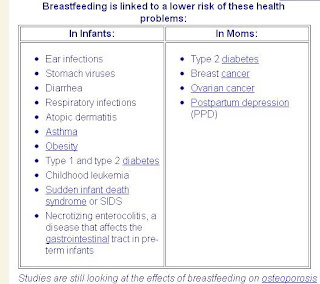

As my dedicated readers know by now, breastfeeding means a lot to me. I believe in the emotional benefits of how it helps nurture an attached relationship, and I strongly believe in it's physical benefits. For those of you who need reminding, here's a quick overview of some of the benefits.
That is just a conservative list, but it clearly shows that breastfeeding is a vital part of healthy growth and development. As such, breastfeeding needs to be supported, encouraged, promoted, and celebrated, which is the goal of World Brestfeeding Week.
This year, the theme of World Breastfeeding Week is the Ten Steps to Successful Breastfeeding.
So without further ado...
Ten Steps to successful Breastfeeding
1. Have a written breastfeeding policy that is routinely communicated to all health care staff.
2. Train all health care staff in skills necessary to implement this policy.
3. Inform all pregnant women about the benefits and management of breastfeeding.
4. Help mothers initiate breastfeeding within half an hour of birth.
5. Show mothers how to breastfeed, and how to maintain lactation even if they should be separated from their infants.
6. Give newborn infants no food or drink other than breast milk, unless medically indicated.
7. Practise rooming-in – that is, allow mothers and infants to remain together – 24 hours a day.
8. Encourage breastfeeding on demand.
9. Give no artificial teats or pacifiers (also called dummies or soothers) to breastfeeding infants.
10. Foster the establishment of breastfeeding support groups and refer mothers to them on discharge from the hospital or clinic.
So pop back in and join me the rest of this week for discussion on the Ten Steps, how we've seen it implemented (or not), and a celebration of breast feeding.
Note- Blogger refuses to let me use "normal font" and is only allowing Small/est or Large/st, I hope I get this sorted out soon.
Subscribe to:
Posts (Atom)